From industrial waste to a new opportunity in farming
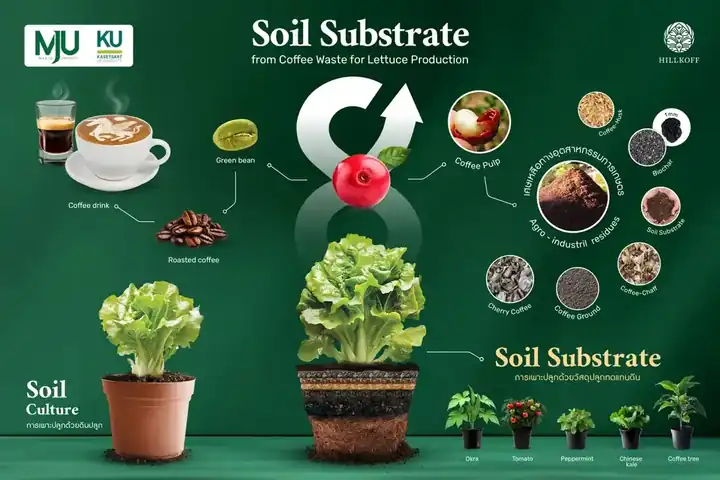
Every year coffee production generates huge amounts of waste — cherry skins, husks and parchment, and spent grounds. Without proper management this waste can become a burden on the environment, contaminating water sources, emitting greenhouse gases or filling more landfill. Yet from the point of view of the Circular Economy, what looks like waste can become a valuable resource. That is what Hillkoff set out to study and develop: a growing medium made from coffee waste for growing lettuce, offering a new way to add value to what the coffee industry leaves behind.
According to 2022 figures, Thailand discards more than 290,000 tonnes of spent coffee grounds a year. Without proper management, leaving them to rot in the open or near watersheds can cause environmental problems. Putting these grounds to new use not only reduces waste but also adds value for the coffee industry and for agriculture.
Biochar: a driving force for sustainable ecosystems
One key ingredient of the growing medium developed in this research is biochar, a charcoal made by heating organic material under controlled conditions — coffee cherry skins, husks and parchment, and spent grounds from coffee shops. Biochar brings many benefits to ecosystems and sustainable agriculture, for example:
1. It makes soil more fertile
• Biochar improves soil structure, so the soil holds water and nutrients better
• It reduces the need for chemical fertiliser, cutting costs and environmental impact
2. It stores carbon and helps limit global warming
• Biochar can lock carbon into the soil for hundreds of years, reducing CO₂ in the atmosphere
• It supports Carbon Farming, farming that helps absorb carbon
3. It reduces pollution from farm waste
• Coffee waste left unused rots and releases methane (CH₄) and nitrous oxide (N₂O), greenhouse gases many times more potent than carbon dioxide
• Biochar helps reduce this and turns the waste into something useful
From local impact to global relevance
Research and development of growing media from coffee waste does not only help Thai farmers raise their yields sustainably; it is also a model that can be adapted internationally, especially in countries where coffee is a major cash crop, such as Brazil, Colombia or Ethiopia. Finding ways to make the most of the waste is a key to reducing the coffee industry's impact on the global environment.
The research also shows that reusing agricultural waste can make farming more environmentally friendly, reduce waste, cut the use of new resources and create a “green cycle” that links agriculture, industry and the environment.
“Developing Soil Substrate from Coffee Waste for Lettuce Production”
Hillkoff and a team of researchers from Maejo University studied and developed growing media from coffee waste. We are preparing to make this research public at The 19th Asian Agricultural Symposium at Tokai University, Kumamoto, Japan, an international forum where agricultural and environmental research from many countries is published and taken into practice, so that anyone interested — farmers, researchers or investors in agricultural and environmental technology — can build on this knowledge and put it to wide use.
Thanks to the research team who developed this knowledge
• Dr Jiraporn Inthasan
• Chatprawee Dechjirarattanasiri
• Naruemon Taksa-Udom
from Maejo University, Kasetsart University and Hillkoff Co., Ltd., a good example of cooperation between academia and the private sector.
Moving forward with the circular economy
Hillkoff invites everyone to learn about innovation from coffee and experience it first-hand at the Integrated Hill Tribe Coffee Learning Centre, Mae Taeng District, Chiang Mai, and to be part of driving the change towards a sustainable world. Because every coffee bean not only gives us a good drink, it can also build a better future for our environment and society.
Compiled by: Hillkoff Academy
Compiled by: Hillkoff Academy